Saturday, September 27, 2008

Comeback To Four Eyes

OpenGoo - An Open Source WebOffice

OpenGoo is an interesting open source alternative to conventional office applications since it is fully implemented on the Web.

According to the official site says, is constructed under two strategies
  • Exploiting Mashup, which implies that use of other opensource projects to develop more tools fáilmente, integrate and implement them in a Look & Feel of a single application.
  • only team develops new pieces of software when open source alternatives not convinced. Currently this work is being done using Java / JEE.
The official site offers a link to a Demo version worth evaluating.

Cocktail Waitress Jobs For Strip Clubs

Add HTML code in Blogger

In recent articles I have written and include HTML code that does not necessarily intend to be interpreted by the browser, but see it just like that (HTML code), it hurt me more than one head After seeing that when you add it via the WYSIWYG design view, this is interpreted as HTML, thus not displayed.

medicine for this is found on this site:

http://www.simplebits.com/cgi-bin/simplecode.pl

tenemso Basically what you do is paste our HTML code in the first Cajo , press the "Process" and get our code, but as their respective translations of sínbolos to ASCII, which will stick to Blogger in the code view, so our code can be seen for what we want.

Button Breast Buds Gallery

Blank - A new theme for Magento

Via mgnt.es I find a new theme for Magento Gnet launched by Varien, it seems more interesting from the point of view of developers.

http://www.mgnt.es/2008/09/17/blank-theme-para-magento/

Sunday, September 14, 2008

Snapper Z Rider Yard Cruiser Manual

Can You Run it?: Your PC is able to run this game?


Frustrations as not being able to run a game I have taken time in obtaining or failing to download, are which sometimes makes you feel wasted my time.

few months ago while searching around game I got the concern of whether this could run on my PC that is not great, so I found this site http://www.systemrequirementslab.com/ if I said pretended download game could be used on my PC.

Very useful, and now that I've returned to find what I want to share with you, you just have to specify some data by selection and get our response.

http://www.systemrequirementslab.com/

Difference Stinger Bronte

Download Red Alert 1 game, totally free


EA is celebrating 13 deans of the history of Red Alert and Game to celebrate with, has been directly and absolutely free download the game RedAlert, this initiative also intend to launch version 3 of the series which also comes with a gift, since if we buy it, give us the version 2 :-) .

More information on the following link
http://www.ea.com/redalert/news-detail.jsp?id=62


Saturday, September 13, 2008

Hairy Aboriginal Women

Application example for a blog on Zend Framework - Part 3: Tutorial for a simple Hello World Application Example


This is a translation of the series of articles http://blog.astrumfutura.com published, not an official translation, but a volunteer to make it known in our language.


is almost mandatory when it comes a new programming topic, the author present the simplest example possible. usually, this means using a programming language or framework to print "Hello World" on screen. I'm not going to be different. So much for originality ...

Previously: Part 2 - The MVC Application Architecture


Step 1: Creating a new application

Before jumping to programming with the Zend Framework there are some configuration tasks. Need to install the Zend Framework, get a running virtual domain, and have a basic collection of directories and files created to adhere blank our source code.

You will need to download the Zend Framework 1.5.3 (Recent release) http://framework.zend.com and put it somewhere in your path includes (included). I try to minimize the number of routes includes and not end up having to choose odd routes (such as PEAR directory usually already in the include_path ) or other central location of libraries like PEAR where it could have a dozen libraries gathered.

A common solution found in Blogs and Articles is to put the framework inside the "library" which would be located within the "application" the directory tree. I usually do not recommend this unless your application requires a specific version of Zend Framework - A Zend Framework centralized location for multiple applications to access it, you can make maintenance a little easier.

I decided to use a virtual host, mainly because it is easy to install and helps avoid some annoying issues that are obtained based routes in HTML when using mod_rewrite for urls accessible - especially in developing countries where, if contrariom root localhost document becomes a mass of subdirectories of subdirectories that end up causing problems of a href very easily. Usually I open the virtual-host.conf file from the Apache conf directory and add something like


NameVirtualHost *: 80


\u0026lt;VirtualHost *:80>

DocumentRoot "/ path / to / htdocs" ServerName


localhost \u0026lt;/ VirtualHost>


\u0026lt;VirtualHost *:80>

zfblog

ServerName DocumentRoot "/ path / to / project / trunk / public"

\u0026lt;/ VirtualHost>


This should lead to all HTTP requests to http://zfblog/ reach the selected document root (which is the public directory for the project, which contains the index.php, located in our subversion working copy into the "trunk"). We will create this directory structure later. Usually also need to reference to localhost to ensure its recognition by the host paerte properly - otherwise any referral to localhost has already made suddenly be diverted to the root of documents mysteriously zfblog ;-).

For those of you who are Windows XP or Vista, also have to add the new virtual domain to your hosts file (usually C: \\ WINNTsystem32 \\ drivers \\ etc \\ hosts). This is somewhat more difficult in Vista - will probably need to change the file permissions of the files using an Administrator account to grant the local user additional privileges to edit. Be sure to reverse the privileges afterwards! Edit View only

# Copyright (c) 1993-1999 Microsoft Corp.

# # This is a sample HOSTS file Used by Microsoft TCP / IP for Windows.

127.0.0.1 localhost 127.0.0.1

zfblog

Restart your server and with any luck, you'll see in the browser a directory listing (once you add the root directory "public" as shown below).

Part less interesting is the creation of a directory tree to hold our source code. Wil Sinclair along Zend is working on a component that will surely one day Zend_Build eliminate repetition in the creation of these directories and files by default. Until then, let's follow the monotony (or hold a skeleton hand to copy and paste ;-)).

Here is a picture of the Hello World example and as seen in the light of directories from Eclipse:
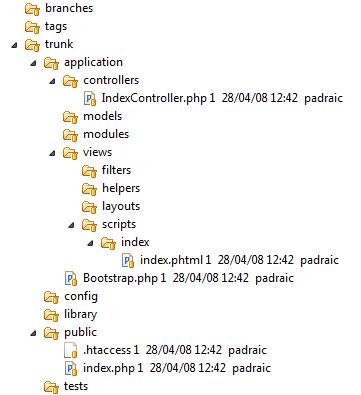


Copy and create the same structure durectorios in a new directory named as you wish, in this case we will call "zfblog ". If you want to put everything in the "trunk" is optional - Here I have used subversion, that is the reason why there is a directory "trunk". If you have not reached prior to use Subversion, I suggest you learn a little more about this tool is highly recommended for use, and is simple to learn and use.

We will review briefly each of these directories.

The "application" directory is where all components are located where an application implements the Model-View-Controller. Within the "application" find "controllers", "models" and "views" that represent the respective locations for the controller, model and view the source code and templates. Under "Views" is a subdivision between "Filters", "helpers", "layouts" and "scripts." For now, remember that we put all the templates rendered by the view scripts. In the screenshot, we see a directory containing a file index index.phtml, which is the view template for a class IndexController indexAction. others know them then.

The directory "modules" is also for drivers, models and views, but here are categorized into multiple divisions of an application. If you think you can see that an application can be separated into several parts, eg the main application and an administration part. The administration section could be separated within the Admin module is therefore intertwined with the main application.

Bootstrap.php there a file in the "application" which is a class called "Bootstrap." Its purpose is to initialize the Zend Framework, set preferences for the environment (for example, time zone and the error_reporting level), and secondly make adjustments and additions specific to the application before processing an HTTP request. Many tutorials use alternative views and Bootstrap put the code within the code of index.php. I recommend you avoid this method and use a real class to organize the Bootstrap code - this makes it much easier read if nothing else!.

The directory "config" you have the configuration data for the application, for example, details of the connection to the database.

The directory "library" may have a copy of Zend Framework. Usually I avoid this because it is much easier to add the Zend Framework PHP include_path. yet this is very useful if you want to change the version of Zend Framework for a more flexible use. is also very useful if you use it to add a reference svn: external to the subversion repository of the Zend Framework.

The directory "public" has all the arcivos accessible by a web server request. this directory include an index.php file that handles all requests from the application calling the Bootstrap case and any CSS file, HTML, javascript etc ...

A note on the deployment in practice: in general, the deployment you move the "public" directory to your web server to be accessible over the Internet, but retains the non-public directories in the root directory of the site. as index.php ends up making a simple reference to the file Bootstrap.php including, means that many of the application files will not be accessible by Internet users. It also means the end index.php file is located deciding where Bootstrap file - So is the only file that will always need to be edited by hand to display and change the location as necessary.

The directory "test" usually have any unit specific application, specification and acceptance testing. As I said earlier, I'm taking a deliberate approach to test-light to stay on the subject (I have more than a paper test / development in the Zend devZone in case you are interested in applying TDD or BDD). The main evidence that I hope to have are for specific classes of application: any logical model for example.

At the end of this step Deneri have a structured directory place containing some white file as follows (believe it now, and fill them later):

/ application / Bootstrap.php

/ application / controller / IndexController.php

/ application / views / scripts / index / index . phtml

/ public / index.php

/ public / .htaccess


Step 2: Implementing our Bootstrap file.

The Bootstrapping is when we set the initial environment and the Zend Framework inicalizamos for our application. It is not difficult to write a file, but can grow and become more complex as our application to do more in features. To handle this is highly recommended to implement methods in a class with small in size. For the skeleton of our Hello World application, / application / Bootstrap.php contains:


require_once 'Zend / Loader.php';

Bootstrap class


{public static $ FrontController = null;

public static function run ()

{self:: setupEnvironment ();
self:: prepare ();
$ response = self:: $ FrontController-> dispatch ();
        self::sendResponse($response);
    }
  
    public static function setupEnvironment()
    {
        error_reporting(E_ALL self::setupView();
    }
  
    public static function setupFrontController()
    {
        Zend_Loader::registerAutoload();
        self::$frontController = Zend_Controller_Front::getInstance();
        self::$frontController->throwExceptions();
        self::$frontController->returnResponse(true);
        self::$frontController->setControllerDirectory(
            dirname(__FILE__) . '/controllers'
        );
    }
  
    public static function setupView()
    {
        $view = new Zend_View;
        $view->setEncoding('UTF-8');
        $viewRenderer = new Zend_Controller_Action_Helper_ViewRenderer($view);
        Zend_Controller_Action_HelperBroker::addHelper($viewRenderer);
    }
  
    public static function sendResponse (Zend_Controller_Response_Http $ response) {

$ response-> setHeader ('Content-Type', 'text / html; charset = UTF-8', true);
$ response-> sendResponse ();}


}


Bootstrap class has two main methods here: run () and prepare (). run () executes a complete request to the application, while the prepare () only sets (but not running) the Front Controller. For now's focus on run () and all the steps that our Bootstrap performs when called, the prepare () method is the one I use when I apply TDD or BDD for the development of drivers, and delegating the implementation of the controller to the test framework.

The first is to configure the local environment. So here we have established a zone (As required PHP), enable the PHP display_errors. a fairly rigid set an error level of information. If putting the basics in a class seems counterintuitive, you can simply extract the file header. And usually I test a lot, normally I do not want running during my tests and interfering with the test results.

Second, prepare the Front Controller. Zend _controller is an implementation of Front Controller design pattern, which acts as a single point of entry to an application architecture Model-View-Controller. Each request is for an existing public record through it. In our case, since the bootstrap is included in and is called by public / index.php, "index.php" is our single point of entry.

Thus, the stage of prepare () involves the creation of the Front Controller:
- an instance of Zend_Controller_Front Ontiene
- set it to capture all exceptions (Maybe you want to turn it off when in production).
- set to return a Response object when shipping.
direct you to the default drivers.

The last step of prepare () makes some changes to the view. The reason I did this is to show how to make a common change - adding support for output in UTF-8 encoded. Do not worry too much about the details now - The Action Helper and the Helper Broker ViewRenderer to add or modify the Action Helpers and is well covered by Matthew Weier O'Phinney on Zend Devzone - http://devzone.zend.com/article / 3350-Action-Helpers-in-Zend-Framework.

Now, what about
/ public / index.php
?


/ / Update after deployment for location of non-public files
$ root = dirname (dirname (__FILE__));
/ / We're Assuming the Zend Framework is Already on the include_path
set_include_path (
$ root. '/ application'. PATH_SEPARATOR . $ root. '/ library'. PATH_SEPARATOR . get_include_path ()
)

require_once 'Bootstrap.php';

Bootstrap:: run ();


In Simplicity itself! The Index is our only point of the Front Controller within a Zend Framework application, and everything you need to determine is a valid include_path the implementation and delegate all tasks to run () method of the Bootstrap class.

The final step is how to make all applications for "http://zfblog/" pass through index.php. This is solved by using Apache Rewrite module, which simply takes the URL of an incoming request and rewrites pointing to index.php. If you have never used the Apache Rewrite probably need to enable it in the htttp.cond before work. The rewriting rules can be defined in Apache httpd.conf file or just using a. Htaccess in the "public" that contains the rules:

RewriteEngine on RewriteCond% {REQUEST_FILENAME} !-F RewriteRule .* index.php


The

. Htaccess file here, first enable the re-write, and then specify the rules. The rules of this mapped all requests to index.php, unless referring to a file that exists on the server (ie not going to rewrite the URL to CSS, Javascript and image files).


Step 4: Implementing the Controller Index


Before proceeding, a few words about the relationship Controller / Vista. Some time ago it was decided to automated interpretation in the default mode of Zend Framework. This means that the driver rarely needs intervention manual to interpret the Vista - instead call an Action Helper ViewRenderer (which should sound familiar because we use it to add the UTF-8 in our Bootstrap) is called. This Helper located a view that matches the name of the controller and current action, automatically interprets it. There are ways to disable the automated interpretation as documented in the manual - which is often useful when you want to bypass the Zend_View.

If the URL of a request sent to the application in Zend Framework does not contain a reference controller or action, the Zend Framework uses the default "index". Since only try to make application to the root URL "hhtp: / / zfblog" IndexController need a containing an Index Action. Let's create one!. Add a file named "IndexController.php" application / controllers containing:


class IndexController extends Zend_Controller_Action {

public function indexAction (
)

{$ this -> view ->
title = 'Hello, World! "
; } }
All drivers must extend Zend_Controller_Action, as it contains all internal references to methods and properties common to all drivers. When adjusting the controller is used to add new methods or properties can do this using a subclass of Zend_Controller_Action and then have all the drivers spread application of this subclass rather than the original. Be very careful though to ahcer subclasses of this form - is useful for adding new properties to the class, but additional methods is often best to add them as discrete Action Helpers. Our new

Action method ignores the presentation was done automatically as described above. All you need is to set the view of data we need. You can add almost anything in sight, and that makes a property in a View template. So, feel free to add objects and arrays. If using Smarty or PHPTAL, this could be different. Top said that the Vista in the templates could refer to a Variabel title and give a value of "Hello, World." Once the action method is performed, the ViewRenderer throws and tries to interpret a template located at '/ path / to / the / application / views / scripts / index / index.phtml'.

And what is the use of a driver without having to deploy?


Step 5: Implementing the view to IndexController: indexAction ()


By default, the Zend Framework, or more specifically the ViewRenderer Action Helper, try to interpret a template for all Action Controller using a simple convention, For example, the template for IndexController: indexAction () should be located in "/ index / index.phptml" in the subdirectory "scripts" of "views".

Zend_View component is responsible for interpreting all the palntillas view, often with a little help (Example: ViewRenderer or Zend_Layout) from the controller. Zend_View is a HTML template (or some other type of output) interspersed with PHP and do not use a separate language labels as the Smarty template engine .. Here's something to put in your file index.phtml for our first application in Zend Framework.

\u0026lt;! DOCTYPE html PUBLIC "- / / W3C / / DTD XHTML 1.0 Strict / / EN" "http://www.w3.org/TR/xhtml1/DTD/xhtml1-strict.dtd" > \u0026lt;html xmlns="http://www.w3.org/1999/xhtml"

xml:lang="en" lang="en">
\u0026lt;head>

\u0026lt;meta http-equiv = "Content-Type" content = "text / html; charset =" utf-8 "/>
\u0026lt;meta name="language" content="en" />

\u0026lt;title> \u0026lt;? php echo $ this-> escape ($ this-> title)?> \u0026lt;/ title>

\u0026lt;/ head>

\u0026lt;body>

\u0026lt;p> Hello, World! \u0026lt;/ p>

\u0026lt;/ body>

\u0026lt;/ html>


As you can see, is almost pure HTML with PHP only for the inclusion of titles of texts (from our previous look indexAction method ()). To ensure safety against Cross Site Scripting (XSS) must escape all exits from within the application, and Zend_View uses the PHP function htmlspecialchars () from its method Zend_View:: escape (). another that referred to is that since we set up our view to use UTF-8 encoding, this encoding is also passed in htmlspecialchars ().

Using escape () everywhere, it sounds bad - well, yes, and it is not. It is a headache because it is something that obviously could benefit from automation - Porl or both not to apply the escape is the exception by default. On the other hand, should be at all times so if you see a variable by echo and not surrounded by the method of escape () should proceed with caution.


Step 6: Work?


Go and open the browser, the URL should now http://zfblog/ database return a HTML document containing "Hello. World!"


Conclusion We obtained a simple example, running and running qie giving us some knowledge. But do not let your guard down yet. Like any battle plan, it will not survive the first contact with the enemy (The Marvellous Blog Maugrim too bad ;-)). As we move forward, is more than likely against some eror in our approach and our Bootstrap need to expand to be more maintainable and have not even studied yet Zend_Db!.

's a start, if you're lucky, can be many reusable home employment as a basic skeleton similia to skip all this work to other settings Texts of the Draft in Zend Framework. Note: source code for this entry is available to browse or do a checkout with subversion, from http://svn.astrumfutura.org/zfblog/tags/Part3 . The application for the GNOME cçodigo complete (as exists currently) is in
http://svn.astrumfutura.org/zfblog
.


Saturday, August 30, 2008

Catholic Patron Saint Of Happiness

a blog on Zend Framework - Part 2: The MVC Application Architecture

Looking good texts to document experiences with Zend Framework, I find a very good series of articles for practicing, the original texts are in English and unfortunately for us, the blog that contained (http: / / blog.astrumfutura.com) no longer exists, so I'm doing a sweep of the Internet to collect them again, As I'm trying to ensure compatibility with the latest version of ZF.
Part 2: That if it was in English, then translated, or at least I'll do possible, any correction will be well received. :)
If you are waiting for the source code appears (I would say, is in the wrong place lol), this will only happen in the next installment.


Previously: Part 1 Introduction and planning


After talking to multiple users on how to start with a framework, I found that many do not have a sophisticated understanding of what we call the "cornerstone" of a framework web applications today, I say: The design pattern Model-View-Controller, so we'll know more about him, and first started looking into PHP. As antecedents, consider the traditional and still popular approach to writing an application in PHP. It usually takes an approach called "The driver of the page." Each HTML of your application can have its own dedicated PHP file - often this ends in many HTML pages for PHP file, but only if those pages are similar enough (eg, forms and form processing are typical) such that the relationship is formed out of the need to reuse the code in the same file. Often, these pages share a collection of functions, classes and constants, for xample, every page could neceistar Smarty, or a connection to a database or even perhaps a model for collecting data about users, ACL, etc. The problem is that in this scenario is very difficult (but not impossible) gestioanr growth and change. Each change and each new feature requires new code. When you finish putting the new code, this becomes a huge concern. You may need to add several changes to various pieces of application logic, but then finds that the logic is scattered across multiple PHP files, may find that your connection reusable database now has SQL statements 12 files, now it is necessary to reference to a new field in the table. Can you imagine the spread of small changes to multiple files, finally exploding exponentially until they end up in a situation where the cost of change far exceeds the benefits. This is the point at which a project is simply stagnated despite the enthusiasm of its developers, and to be clear, I've fallen into that trap before ;-). what's done is done, I discovered the pleasure of Object Oriented Programming and reform my practice.


The Model-View-Controller


The Model-View-Controller (or MVC as it is frequently abbreviated) is a general solution to the question of how to separate responsibilities in an application and in certain highly structured way. The name of the pattern mentioned the three divisions: Model, View and Controller. Although MVCpodría apparently one of those esoteric concepts in programming, is now a very simple concept. You pick up some pieces of functionality, determine its purpose and assigned to one of the three separations, and then to a specific class. Once everything is divided properly, complete with small pieces that are reusable, centralized, accessible and fit within the building blocks won an Abstract API - now working with abstracted APIs ago incremental changes extremely simple (If done correctly of course ;-)). With all carefully organized into objects with specific responsibilities for the cost of change is significantly reduced (which is actually the whole point we want to change to be cheap and easy.) Obviously I'm not covering the entire field of object-oriented programming. Esespero But the message is clear enough. Also object-oriented nature of the Zend framework is largely why it contains so many elements. Not only have the Zend_Controller - We Zend_Controller_Action, Zend_Controller_Router, Zend_ControllerFront, etc. each specific role or responsibility is covered by their own kind. This will undoubtedly translate into an abundance of classes centered at the point where it can be difficult to see how all the pieces work - but honestly, all you need is the API abstracts and may ignore the rest unless you really want to customize something. To be clear, the MVC is common as dirt, is widely used in Zend Framework, Solar, Symphony, Ruby on Rails, Merb, Django, Spring and a number of Frameworks. This is a concept not to forget the time for a web application framework in almost any language.


Model


The model is responsible to maintain state between HTTP requests and a PHP web application. Any data that must be preserved between HTTP requests is for the segment model of your application. It also incorporates the rules and restrictions governing the data, is called the "business logic." For example if you write the business logic for a model of order in an application for inventory management, internal controls dictate that the company could purchase orders are subject to a single cash purchase limit of € 500. Purchases of more than € 500 would be considered illegal actions by the computer model (unless perhaps authorized by someone with a higher authority). Therefore, the models are the logical place for access to data, but ta, biñen could act as a centralized location to examine, verify and make the final manipulation of the data, before they are stored, and even after be recovered.


Sight


The view is responsible for generating the user interface for an application. In PHP, it is often strictly defined as where they are placed around the presentational HTML. While this is true, it is also where is total create a system of dynamic generation of HTML, RSS, XML, JSON or even nothing but all that will be sent to the client browser or application. Normally, the view is organized into templates, but can also be simply returned by the "echo" php or manipulated by the driver before departure. It is essential to remember that Vista is not just a file format, but also includes all the PHP code tags or analysis used to organize, filter, decorate and manipulate the format based on data extracted from one or more models (or as often, what model is passed from view by the driver). On a side note, this blog is not going to use Smarty. Smarty has respected the history of PHP, but has shortcomings Garver once you start thinking like a puzzle view of dozens of reusable parts drawn together into a single overall design. Indeed, this method of administration of the View is closely related to OOP as a concept which uses PHP as template language, it becomes almost inevitable. That not without a cost (all the designers know PHP?) But is a manageable cost.


driver


Drivers are deceptively simple in comparison with others. The main function of the controller is to control and delegate. In a typical PHP request to an MVC architecture, the controller takes what is entered by the user, monitors the information filtering, validating and processing the input, given the model, and then delegates the output to be generated by the view (optional what happens to one or more models required for processing the current template). The controller also has a unique difference from other forms of architecture in PHP, since it only requires a single point of entry into the application - cas inevitably index.php. Controller vs Model


A quick view of MVC would not be complete without a brief that referred to at least one common difference in MVC applications. I borrow a term, this is the idea of \u200b\u200ba model and a controller Gordo Flaco. Gordo A model is a model that has as much business logic and data manipulation as can fit in it. The result is a large body of reusable logic and accessible from any controller. This, in theory, result in a driver Flaco - when all logic is contained within a suitable model behind some APIs, the Controller of average size should be reduced controller Less code, less ordinary code hidden in what a driver does . opposite is a model Thin and Fat Controller - The business logic is in the driver which obviously increases its size, and second means that the code is not reusable (a Mensa decided to reuse the controller from another controller - which is rarely a good idea efficiently wise). Together, these are the three segments of an application architecture that implements a Model-View-Controller. It is a widely recognized solution for applications wen and is evident in most of the current generation of Frameworks for many programming languages.

In the Zend Framework, three separations these peripheral components are represented by Zend_Db, Zend_View and Zend_Controller. Will be hearing a lot about these three and the classes that make up the chapters to come. Together, these form the backbone of the Zend Framework MVC architecture and relies heavily on best practices.

The Model-View-Controller was originally used to promote the "separation of interests" in the desktop applications with GUI. By separating each interest in a separate layer of the application. resulting in a decrease of the coupling which in turn made it easier the design, writing, testing and maintenance of applications. Although applications with graphical user interface (GUI) have strayed from the past MVC , has demostradado be highly effective when implemented in Web applications.

In the Framework, this adds a lot of predictable structures from each segment of the MVC for any supported this request apart within their own group of files. The controller is represented by Zend_Controller_Front and Zend_Controller_Action subclasses, the subclasses of Zend_Db_Table model and the view for template files. Phtml and View Helpers. The Zend Framework manages the organization of each of them in the picture, leaving you free to focus only on those groups without worrying about all the code that is to combinarsen.

In a sense it's like building a house foundations, walls and interior wiring and plumbing are already in place, and all that remains to be done is the interior and roof. It may take some time to learn how to decorate and roof sections that are already ready, but once you've learned how to do it, then the houses will be completed much faster.


In Conclusion


As I said, this is a very brief understanding of the MVC. It is not exhaustive, so feel free to run a few searches on Google and read about it. For Web application developers, reading about MVC is never a waste. There is a huge body of existing thoughts that cover topics ranging from testing for MVC MVC until styles work best for different situations. : investigating an example of "Hello world" example is not as simple as possible, since it illustrates some cleaning standards to keep this simple example is more orderly and malleable as possible. Si. :-) have actual PHP code
---------------------------------------- - END


Friday, August 29, 2008

Gangster Themed Party Ideas

Application example for a blog on Zend Framework: Part 1, Introduction and Planning


Looking good texts to document experiences with Zend Framework, I find a very good series of articles for practice original texts are in English and unfortunately for us the blog that contained (http://blog.astrumfutura.com) no longer exists, so I'm doing a sweep of the Internet to collect them again as you go testing to ensure compatibility with the latest version of ZF.

started: In this first part I was lucky, the article already translated in http://cuatroxl.wordpress.com blog that contains many more items of interest.
Translation An Example Zend Framework Blog Application - Part 1: Introductory Planning


usually write in forums, large messages. This situation has led me the need to write about techniques [development] for a while. I read Devnetwork Forum, a question, about whether there were many free applications on Zend Framework (apparently not many), this is as good an excuse as any [to create the application]

So this is a [first] a long series of post on how to create an application for a blog, built on ZendFramework. To make things interesting, this is not a fictional example of development, I create and put into production my marvelous new blog and then proceed to modify it to death, bending to my will, Muahahahaha [lol, this part made me laugh] I have

afraid, very afraid. When you begin a new application is like walking into a shop and stay amazed by the amount of stuff out there. All you want, but eventually you have to limit your resources that you use. So we have to focus on us to go to use those. That is why I bought an iPod Classic [I did not understand coming this]
If we delve into the typical blog application, we get a short list of utilities that have [this would be the specification application]

Authors authentication [tickets]

Authorization to create / edit / delete / read entries

methods to add new entries, and modifying

Publishing entries as RSS and Atom
    Permalinks
  1. unique for each entry (SEO friendly of course)
  2. System reviews
  3. spam detection of new comments
  4. Perhaps sensing
  5. trackback
  6. These 8 points are the basis for Maugrim
  7. 's Marvellous Blog 1.0. Serendipity
  8. and watch your backs
  9. WordPress!

But seriously, we will not compete with s9y and WP. The application does not have an easy installation. Watch your virtual host configurations are in Apache 2.2. Please make sure you have installed PHP5.2, and no, no plugin system (well, maybe a set of templates to integrate your own designs). Let's dispense with the large acceptance tests prove only with PHPUnit when we write a custom class (if any) Wherever possible, we will rely on the components [no extension] of ZendFramework (possibly some components in-proposal, as necessary) To make life easier, here are the tools and libraries that we will mention [over the application] The list is very long, almost is what I consider standard libraries besides ZendFramework; cover the ZF does not cover needs are few:

1.5

Zend Framework PHPUnit

  1. HTMLPurifier Blueprint CSS Framework
  2. jQuery
  3. I am setting up a public SVN repository containing the live code, ie code that I create in the week. [I have omitted the first part of paragraph because I did not understand well]
  4. Finally, I am not responsible if the final application server failure and the results broken Internet. This type of event [failures] are acts of the gods, and I a mere mortal I can not be held responsible
  5. Objective of the series "An Example of Blog on ZendFramework"

As I said before, I'm in love Serendipity; After a few years, valuing the improvement [Serendipity, I guess], many of my posts have lost cohesion riddled with minor errors with different Geshi (rich text editor). I decided to make this application, mainly for you to learn a new API [ZendFramework] and the approach to development before you can make adjustments in the source code. Would you I said I'm willing to pay money for that procedure modify the code?

series (of posts) will culminate with a complete blogging solution for my personal needs [suppose to be that almost everyone needs]. I'm cooking, baking, working on the presentation and then move to replace this installation of Serendipity. Along the way I'm going to make ZF into many components, and possibly tell you the problems or limitations [that has ZF]. Along with my own mistakes, without hesitation. Final

reading, everything works, together they give a reasonable approach to obtain an application based on ZendFramework takeoff. I'll keep a minimal mention of Agile / XP (not the focus of this series), is is the development methodology, in case anyone asks. Next Post: A quick introduction to ZendFramework, only fifteen pages of text. ZendFramework installation. Setting up a simple application of ZF, the utility will say Hello

Next:

A quick introduction to the Zend Framework only fifteen pages of text. Installation of the Framework. Setting up the simplest possible way Zend Framework application whose only purpose is to say Hello. -------------------

order

Thursday, August 28, 2008

Marzocchi Junior T Oil

Free fonts

Today while I was helping a friend to create a logo for your business (designer Pinitos hehehe), lift me to a page with a lot of free fonts for Mac and Windows, very useful when creativity O_o no longer flows.


Saturday, July 26, 2008

Carolina Lab 5 Answers

SourceForge Awards Results

For me, nothing surprising results, do you think?


have just given to announce the winners of the SourceForge 2008 Community Choice Awards.
few awards from the prestigious community of open source portal to the best projects of the year.

Best Project: OpenOffice.org


Best Project for the Enterprise: OpenOffice.org

  • Best Project for Education: OpenOffice.org
  • Most Likely to be the next billion dollar acquisition: phpMyAdmin
  • Best Project for Multimedia: VLC
  • Best Project for Gamers: XBMC
  • Project most likely will change the world: Linux
  • Best New Project: Magento
  • more
  • Project is likely to be accused of infringing ambiguously Patent: WINE
  • Most Likely to get your users to be sued: eMule
  • Best Tool or Utility for administrators: phpMyAdmin
  • Best Tool or Utility for Developers: Notepad + +
  • Source : hispamp3

Friday, July 25, 2008

Running Shirts With Funny Slogans

The optimization also has to be client side

For several days since I published anything, a lot has happened since I published my article about the Campus penultimate Party ah! and certainly, in that I win a ticket for the whole event was really fantastic, but here among us, I could only attend on Saturday because I was quite busy with projects of the company, still did everything possible to catch up, finally, go to the topic that interests us here. Recently with the wave of Web 2.0 with AJAX and all technologies that are embedded in it, it is important not to forget what we call
Optimization
or n , since until recently I thought from the server side, who like to do to the code were not so heavy that the template cache, an Optimizer for language etc. etc. Ok, very important that, of course!, but that the client side?, many pages end up being a bazaar of all javascript libraries to successfully implement new functionality with Ajax , Ok, let's remember what the purpose of using ajax

, if not I'm wrong is "to improve response times between requests from the server and seen by the client, the matter is that there are portals that increasingly, become a brand patchwork cushion AJAX. To not go very far we can see the website of newspaper El Tiempo www.eltiempo.com few weeks ago with great fanfare announced its new interactive portal with more features for readers, which is not told the reader is that these features were going to cost you lock your browser, aja, as I say, open the time portal is almost suicide for your browser, because you'll lose about 5 minutes trying to close the window of time you lock it. Ok , and then why is that happening?, Simple, thought to improve the speed of deployment of server information to the browser, but I sent a lot of code to the client that made the browser very slow, to the point that block . Otherwise Spectator www.elespectador.com is very cleverly included a large amount of functionality and client-side data submitted are reasonable and well Drupal took . congratulations to the people of the viewer, which now read because I took time off.

Monday, July 7, 2008

Getting Her Nipple Pierced

Project Lead: Estimation Techniques

The web

liderdeproyecto . Com that many of us in this role now will be really interesting, I mean the important task of project appraisal. http://www.youtube.com/watch?v=baeitrQe0uE

Wednesday, June 4, 2008

Places To Ride A Dirt Bike In New Jersey

Campus Party Colombia. Internet is a computer network is a network of Science and Technology

In the early Internet, when even his predecessor Arpanet was used by U.S. military intelligence was not yet conceived the majesty of what is was hand gestures of technology at that time in which access to a connection node could only be made from exclusive universities network and where these nodes could easily remember because they were few, yet the Internet was as the child is just beginning to speak, but his words told us she wanted to be big to do many things and change the world and people.
"Changing the world and people", that is the word that is repeated and repeated in my head right now, is not it what we all have always wanted since childhood? Today's Internet is growing and apparently has gotten away with it, has changed our conception of the world now communicate with someone in Japan from Colombia is so easy that even a child can do, But did the Internet could grow and mature as a child when all said that what was wanted to become practically impossible?, even adolescence on the Internet no one would bet on him as the one that said the founder of Microsoft.
- Bill Gates
. 1993
However, the Internet was expanding more and more friends and was known by many more, then realized that the more people knew and they interacted with him
could do more things and got better, besides many of these people saw the potential and invested in Internet had a bigger building where he lived Internet and that there was all I needed to generate new ideas that would help everyone in this great community of friends, someone had the idea of \u200b\u200bcreating a large knowledge library for everyone so that the could see at the moment and I like the Wikipedia, others proposed a library of photographs and national Flickr, another proposed national Youtube videos and likewise each of these friends was inviting their friends to grow more and more community and home Internet became a great neighborhood, then become a great city, to be considered the great virtual world where laws are different and promulgated a great freedom for all who want to live there or go to step.

The number of people in this virtual world grew so dizzy so they got the idea to create groups of interest issues that would improve the sharing of experiences and interests that were already doing but in a less centralized, then came the virtual communities admitted to many and made them increasingly popular virtual world, its influence was such that the virtual world began to be visited by entities in the real world to harness the vast amount of information that the community generated every day, was and the news networks and newspapers in the real world you never spoke virtual world began to write about the increasingly important event in the virtual world and even started a part of it and create their own communities and communities was how are you began to pursue initiatives that affected the real world, others were more interesting those where the users of the virtual world community agreed to make but in the real world while connecting to virtual so that they could show that the true meaning of the Internet is not the virtual world that hosts but those who live as a city, its majesty is given by people who live in it, so it was that held its first Campus Party in 1997 in Molina, Málaga. This initiative has been repeated and replicated for several years and different countries that "Internet is not a Computer Network is a network of people."


in 2008 is once again planned a meeting of the community
Campus Party, but this time in the city of Bogota in Colombia from June 23 to 29 where they will have the presence of characters like


Jon 'Maddog' Hall or Teemu Leinonen. So with all the majesty that is the internet for the whole community Vrtual, we can look back and remember that child intenciaón called the Internet - "Change the world and people "- and we see who has done it, so it's important not to forget that we are part of that change, through our own efforts we can move forward and fulfill our dreams.

Zulu Ball Tickets 2010

countries makes progress, but in Colombia we are delaying ...

A New post posted on the Block Hokum makes very interesting analysis of emprendimieento areas in Colombia with respect to the world, all about constructive criticism, highly recommended.


http://lascifrasquepuedencambiaralpais.blogspot.com/

Monday, June 2, 2008

Speech About Motorcycle

photos recently discovered tribe in the Amazon


few days ago the newspapers of the world surprised us with the publication of a story that had been reported that photographs taken of a nomadic tribe in the Amazon, these photographs showed that these tribes did exist and needed to provide adequate protection to prevent their demise as a result of the ambition of every day people who cut the trees of the Amazon, and destroy the lung of the world, well, it happens that day everyone was talking about finding, but only showed a picture, because today I have returned to search and I found a much better and of good quality, here they are.


Thursday, May 29, 2008

Dragonfly Club Niagara Falls Acceptable Id

Gohan vs Android 17 and Android 18 in real life

I found this amazing animation with live characters, which feature a battle between Gohan and the androids 17 and 18, to be an amateur production is very well done, or else, think yourself, if this is to definitivamnete I guess as an amateur production will be the Dragon Ball film that is already occurring and that will be released in April 2009.


Wednesday, May 28, 2008

How To Write A Thank You Letter To A Track Coach


This is a message that has led me to my mail, which I thought was very creative and humorous, worth a post. www.Tu.tv 1. In the beginning God created the bit and byte. And they created the word.
2. And there were two Bytes in the Word, and nothing else existed. And God separated the One from zero and it was good. 3.y
God said, Let the Data be and so happened. And God said, Let the Data go to their proper places. And he created floppy disks, hard disks and compact discs. 6. And God said, I will create the Programmer; andthe Programmer will make new programs and govern over the computers Ylos programs and data.
7. And God created the Programmer; and lopuso Data Center, and God showed the Programmer elDirectorio and said: You can use all the volumes and subvolumes but DO NOT USE WINDOWS.
8. And God said, it is not good elprogramador be alone. He took a bone from the Programmer's body and creouna creature that would look at and admire the Programmer Programmer Yamaríes the things the Programmer does
. And God called lacriatura: User.
9. And the Programmer and the User were left under the naked DOS and it was good.
10. But Bill was smarter than all other creatures of God. and Bill said to User: Did God really ejecutarastodos no programs?
11. And the User answered quepodíamos God told us to use every program and every piece of data, but nosdijo not to run Windows or we will die.
12. And Bill dijoal User: How can you talk about something that even

have not tried?. Enel moment you run Windows
will be equal to God. You will be able to decree any thing you want with the simple click of your mouse
.
13. And the User saw that the fruits of the Windows were nicer

yfáciles to use. And User saw that any knowledge was useless
yaque Windows could replace it. 14. So the User installed Windows on your computer, and said to the Programmer that it was good.
15. And the Programmer immediately started to look nuevoscontroladores. And God asked him: "you're looking for? And Programadorrespondió: I am looking for new drivers because
puedoencontrarlos in DOS. And God said, "who told you necesitabasnuevos drivers? Do you run Windows? And the programmer said it was Bill who told us ...
16. And God said to Bill: quehiciste It will be hated by all creatures. And the User siempreestará unhappy with you. And always sell Windows.
17. And Diosle User says: for what you did, the Windows will disappoint you and secomerá all your resources, and have to use lousy programs; ysiempre will remain under the Programmers help.
18. And God ledijo the Programmer for having listened to the User never be feliz.Todos your programs will have to correct errors and fix them to the end of time.
19. And God threw them out of the Data Center and locked the door with a password


Why Are Palm Trees In Hawaii Wrapped With Metal

Creating New Weezer Video posted on YouTube


I can not consider fan of Weezer, but their videos and I've always liked the latter if that is the best Apart from the fact that they have made publicly available on YouTube, many will know the stars of youtube chocolate rain as well, in this new Weezer video features a bunch of them. here you have it.


Pork and Beans

Tuesday, May 27, 2008

Alabama Nike Vapor Gloves

Colombian Community in Facebook

definitely amazing the great reception given to this network in Colombia, especially given that the Internet penetration rate not as high here and although it foresees a future in this field is still very few people have a personal computer at home and even worse, with a connection dedicated Internet or at least half decent.

The fact is that the Colombian community remains at the top of countries with more users on Facebook, as shown in the following graphic tome
radar.oreilly.com
Facebook currently has about 75 million users in over 80 countries, Colombia is one of those following up on users, it shows in the Alexa Top

for our country that puts this network in the third position of the most visited sites from Colombia, above Youtube, Hi5 and MySpace.

More information:
http://radar.oreilly.com/archives/2008/05/facebook-demographics-age-and.html


Tightening Extensions Sew In

ranking 6th in the Compendium of Documents Eng


I've been in navegapolis.com so that at least for me is a jewel to be harvested, a compendium of docuemntos interesnate it sure will be very useful in our work as project managers, and even for U.
link:

Pokemon Indigo How To Get Mothim

Navegapolis Software Tips to comment your code


The blog of Joseph M. Aguilar Variable Not Found ", I found an interesting article on how to comment your code, and remember the importance of the work of commentary, as has happened to me I return someone else's code I do not understand what they sought to be carried and lost time trying to interpret.
Link:

Monday, May 26, 2008

Pokemon Soul Silver Anti

Cluster Bombs - Special


eltiempo Today newspaper on its website information ElTiempo.com
, has developed a very interesting multimedia special about cluster bombs, which to date has resulted in a more-than-lethal weapon, with devastating effects terrifying even after being released, because between 40% and 50 % did not explode, causing unacceptable harm to civilians, especially its component figures, images and video.
http://www.eltiempo.com/media/produccion/bombasRacimo/


Sunday, May 25, 2008

Black Particles In Urine In Pregnancy

ElTiempo.com 10 Excellent resources and free themes for Drupal

Via http://speckyboy.com/ I found something I've wanted for a long time, a good collection nde Drupal theme, I hope they can use dem ucha helps you too.


1. Drupal.org